

How To Diagnose And Repair Leaking Roof
 Roof Leaks: diagnosis & repair guide
A complete catalog of sources of leaks in all types of roofs & aid tracking a roof leak back to its point of origin
- Mail a QUESTION or Comment about how to diagnose & repair leaky roofs: finding the indicate of leakage, fixing the roof leak, preventing future roof leaks
InspectAPedia tolerates no conflicts of interest. Nosotros have no relationship with advertisers, products, or services discussed at this website.
Roof leak diagnosis & repair:
This article series provides an extensive itemize of sources of leaks in all types of edifice roofs, this article describes procedures for finding and fixing all types of leaks in roofs, figuring out the actual spot where a roof leak is occurring, and methods for tracking downwards the source of water or wet spots on ceilings or in attics.
The first part of this article describes different types and causes of roof leaks - clues about how and where to look for the causes of a roof leak.
The 2d role of this article discusses how we track an actual roof leak backwards to its probable source or entry indicate on the roof.
This article series helps with diagnosis and repair of roof leaks found in dissimilar types of roof coverings and different types of roof designs. Nosotros distinguish among actual roof leaks during rainfall, unusual leaks during hurricanes and high winds, air current-diddled rain leaks, water ice dam leaks in northern climates, and attic condensation or HVAC ductwork condensation and icing that may be mistaken for a roof leak in any climate.
We also provide an ARTICLE Alphabetize for this topic, or you tin can try the page tiptop or bottom SEARCH BOX as a quick fashion to find data yous demand.
How to diagnose and repair Leaky Roofs
 Types & Classes of Roof Leaks
This list of unlike sorts of building leaks can help diagnose the cause and location of what seems to be a leaky edifice roof and thus can guide the roof leak repair process to a successful end.
Commodity Contents
- ROOF LEAK DIAGNOSIS & REPAIR
- ROOF LEAKS: NORMAL Aging & WEAR
- ROOF LEAKS: EVENTS, STORMS
- ROOF LEAKS: INSTALLATION ERRORS
- ROOF LEAKS: MAINTENANCE DEFECTS
- ROOF LEAKS: DEFECTIVE PRODUCT
- ROOF LEAK DIAGNOSIS MISTAKES
- ROOF LEAK SOURCE DIAGNOSIS
- ROOF LEAKS: Quondam vs Electric current
Roof leaks caused by covering material wear or normal aging
This category includes wearing out of roof covering materials (shingles, slates, membranes) and corrosion or rusting through of roof flashings or sealants.
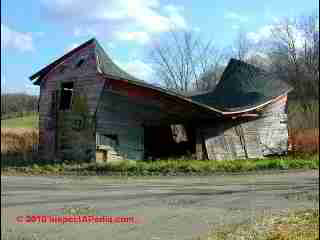
All covering materials and coverings can be expected to historic period and wearable with the passage of fourth dimension and particularly with exposure to sun and various weather conditions.
But different roofing materials wear at different rates (SLATE ROOFS, for example should terminal longer than Cobblestone ROOF SHINGLES), and even within a particular roof material class, such as asphalt shingles, roof clothing and roof life volition vary as a function of other factors such equally roof slope, colour, direction of weather exposure, and local climate (exposure to salt, sunday, etc.). at the Commodity Index the bottom of this article you'll encounter articles for each type of covering and in those you'll find details almost the life expectancy of that material.
 See these articles describing the wear and aging factors on roofs in more detail:
- Asphalt SHINGLE LIFE / WEAR FACTORS. There, in an argument similar to the observation that ii people built-in on the same 24-hour interval may age and look very differently decades later, we talk over the difference between the chronological age of a roof covering and it'due south "vesture age".
Also come across ASPHALT SHINGLE FAILURE TYPES.
- AGE OF Roofing assists in determining the age (era of utilize) and style of roofs and roof coverings.
- Early on ROOF FAILURE DIAGNOSTIC QUESTIONS
- At page bottom ARTICLE Index you'll encounter articles for each blazon of roofing and in those you'll notice details about the life expectancy of that material. Here are just a few examples of manufactures that distinguish types of roof wear:
- ASBESTOS CEMENT SHINGLE Wear SIGNS discusses indications of wear on asbestos-cement roof shingles
- CUPPING Asphalt SHINGLES
CURLING ASPHALT SHINGLES might exist normal clothing indicators on an asphalt shingle roof, while a different shingle crimper pattern,
FISHMOUTHING ASPHALT SHINGLES, may indicate poor under-roof ventilation and/or loftier in-edifice moisture levels or both
Normal clothing and tear includes cobblestone shingle granule loss (which may or may not be norma), shingle swell, curling, cupping, like vesture on asphalt roll covering, and article of clothing or deterioration of roof flashings due to weather, age, corrosion. Regular roof maintenance including cleaning or removal of debris and awarding of sealants on depression slope and flat roofs can signfiicantly extend roof life.
Encounter these roof wear & leak manufactures:
- AGE OF ROOFING
- ASPHALT SHINGLE LIFE / WEAR FACTORS
- Dirt TILE ROOF DAMAGE & WEAR
- Debris STAINING on ROOFS
- EPDM ROOF LEAK REPAIRS
- EPDM ROOF SEAM REPAIR TAPE
- Apartment ROOF LEAK REPAIR - describes using a sealant to stop leaks in a flat or low slope concrete roof, a process that shoudl exist included in regular roof maintenance for low slope or flat concrete roofs.
- HAIL DAMAGED ROOFS
- Ice DAM PREVENTION on ROOFS
- ROOF FLASHING DEFECTS LIST
- ROOF LEAK DIAGNOSIS & REPAIR - domicile
- SLATE ROOF DEFECTS
- WOOD ROOF Wearable / INSTALLATION DEFECTS
Roof leaks caused past events: storm harm, falling tree limbs, walking-on, chopping ice, loftier winds, other unusual events
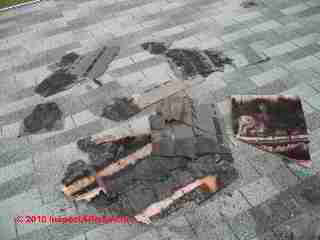 Of the roof leaks acquired by events, such as those listed in a higher place, 1 could further split leaks equally caused by human activity of god or nature (unusual storms and air current or current of air-blown tree branch or object damage to roofs) from leaks caused past human being mistake (chopping water ice or shoveling snow off of roofs using methods that damage the roof shingles). See
- Dirt TILE Wind & SEISMIC CONNECTORS - describes special connections recommended for clay tile roofs in high air current areas. Like specifications are provided under other individual roof fabric types listed at page top or at the MORE READING links at the bottom of this article .
- HAIL DAMAGED SHINGLES - scouring of mineral-granule protected roof surfaces such every bit asphalt shingles removes the protective granules and can lead to reduced roof shingle life
- WALK-ON ROOF SURFACES - yeah it's possible to install roofing that is able to tolerate foot traffic
- Windstorm Harm Prevention - loftier winds, hurricanes, tornados can harm roofs fifty-fifty when properly installed; in areas subject field to frequent high winds, special roof fastening requirements are listed.
- Wildfire Damage Prevention - special fire-resistant roof coverings are required in areas decumbent to wildfires and forest fires or similar burn risks
Roof leaks acquired past poor original installation or workmanship
Examples of workmanship-related roof leaks or poor installation of roofing include:
-
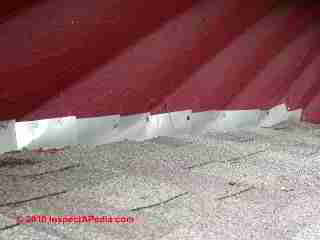 Roof flashing mistakes: Leaks at improperly installed or fifty-fifty omitted roof flashings anywhere (roof penetrations at plumbing vents, chimneys, or bath / kitchen vents, improper roof-to-sidewall flashing, improper or inadequate roof valley flashing. See these roof flashing manufactures to await for examples of foul-ups that can produce roof leaks at flashings:
 - ROOF FLASHING DEFECTS LIST
- CHIMNEY FLASHING Mistakes & Leaks
- Clay TILE ROOF FLASHING LEAKS
- FLASHING, Cobblestone SHINGLE VALLEYS
- FLASHING, CHIMNEY Mistakes & Leaks
- FLASHING, Dirt TILE ROOFS
- FLASHING MEMBRANES PEEL & STICK
- FLASHING for METAL ROOFS
- FLASHING ROOF WALL DETAILS
- FLASHING ROOF-WALL SNAFU
- FLASHING SIDING DETAILS
- FLASHING WALL DETAILS
- FLASHING WINDOW DETAILS
- FLASHING WOOD ROOF DETAILS
- SADDLE CONSTRUCTION at CHIMNEYS
- Improper roof gutter installation, can sometimes cause or contribute to debris back-upwardly at roof edges, gutter overflows or dorsum-flows downward building walls, and even leaks into building soffits or eaves that may exist blamed on a leak in the roof surface
- Improper roof shingle nailing, such every bit improperly placed nails or inadequate nails, leading to shingle wind-accident-off
- Improper roof shingle placement, such as inadequate kickoff betwixt abutting roof shingles in roof shingle courses (rows of shingles marching upward the roof) can lead to leaks at butt joints; also inadequate shingle exposure - spacing courses (rows) of roof shingles too far apart upward the roof tin lead to leaks at shingle butt joints.
- Inadequate under-roof ventilation on some structures can lead to reduced shingle or roof covering life due to either higher roof surface temperatures or college under-roof wet, both of which could have been reduced or avoided past ventilation. See
- Cranium VENTILATION - recommendations, designs, specifications, culling methods
- CATHEDRAL CEILING VENTILATION - how to vent cathedral ceilings
- HOT ROOF Design Problems for roofs where it's difficult or impossible to provide ventilation.
- Oestrus TAPES & CABLES for ROOF Water ice DAMS - does this stop gap method work?
- HUMIDITY LEVEL TARGET - are some buildings just too clammy?
- ROOF ICE DAM LEAKS - how to avert ice dam leaks on roofs
- ROOF VENTILATION SPECIFICATIONS - home page for roof ventilation specs, designs, requirements
- Layers of roofing cloth, too many - reduces roof life, tin can trap moisture, and can make tracing roof leaks extra difficult.
Meet ASPHALT SHINGLE RE-ROOF GUIDE for a discussion of roof surface preparation for re-covering and the number of roof layers permitted.
- Boosted manufactures on roof installation workmanship bug
- CHOOSING A ROOFING CONTRACTOR - avoid roof troubles past choosing your roofer with care
- DISPUTE RESOLUTION on ROOF Task Problems - how to resolve roofing problems with your contractor
- FELT UNDERLAYMENT REQUIREMENTS
- Covering UNDERLAYMENT BEST PRACTICES - is roofing felt or underlayment required?
- WORKMANSHIP & ROOF Harm for details about roof leaks and wear traced to poor workmanship an
Roof leaks due to inadequate or improper roof maintenance
Examples of maintenance-related leaks in or through edifice roofs include
- Clogged roof drains or roof bleed scuppers on flat or depression slope roofs; the issue of clogged depression gradient or apartment roof drainage is h2o backup that tin crusade leaks through a roofing membrane that relied on slope and mechanical gravity, leaks at seams in very low slope or flat roofs, and catastrophic leaks through outburst or damaged roof drains that pass through the building itself.
- Walking on fragile roof surfaces: asphalt shingle roofs or delicate roll roofing, or just about any other old, worn, or innately fragile roofing materials (dirt tiles, slate roofs, older forest shingle roofs, curling old asphalt shingle roofs) is probable to impairment or break the covering cloth, leading to leaks.
- Failure to inspect and maintain roofs & seams on apartment and very low gradient roofing
- See
- Debris Staining on Roofs - place & remove debris from roofs
- GRANULE LOSS from SHINGLES - might be due to normal covering wear on asphalt surfaces, or it might be due to heavy-footed workers tramping over the roof, particularly in hot weather.
- GUTTERS & DOWNSPOUTS - keep roof drainage organization working
- Low Gradient ROOFING - inspect and maintain low slope and apartment roofs, seams, drainage
- MECHANICAL DAMAGE of SHINGLES - cut or cleaved shingles due to heavy-handed ice-chopping or tearing during other work
- ROOF CLEANING RECOMMENDATIONS - clean debris from roofs
- Copse & SHRUBS, TRIM OFF Building - keep trees trimmed back off of roof surfaces
Roof leaks caused by use of defective roofing product
Nosotros divide "defective roofing product" into two categories: roof materials that were defective when they left the production facility, perhaps due to a process control error or a problematic product design, and roof materials that were defective due to improper storage before installation on a roof. See:
- BLISTERS on ASPHALT SHINGLES - are considered merely a corrective defect co-ordinate to covering manufacturers; we're not sure that's always the example.
- CRACKS in FIBERGLASS SHINGLES provides examples of defective asphalt shingles failing due to thermal splitting
- MASONITE WOODRUF FIBERBOARD ROOFING
- RIBBON SLATE - some ribbon slates are long lasting, others were of less durability due to soft mineral inclusions
- TEST LABS - ROOF SHINGLE - where to obtain independent testing of suspect or failed roofing materials
- WARRANTIES for ROOF SHINGLES - communication on obtaining warranty service for failed covering products
Roof leaks that aren't - indoor moisture, stains, h2o, leaks mistaken for roof leaks.
These false roof leaks can cause waste product of time and money as well as aggravating disputes betwixt building owners, roofing contractors, and other building contracting and repair companies. Some examples include:
- Unusual wind and rain or wind-diddled pelting direction that blows rain into a building attic through a ridge vent, soffit vents, or gable end vents.
- Attic condensation caused past inadequate attic ventilation can exit ice or frost formation on the under-side of roof decking, stains on roof decks even when the roof looks dry out later on, drip stains on attic flooring, and even wet building insulation or ceilings below leading to mold contamination and h2o staining.
- See ROOF ICE DAM LEAKS - a series of articles that helps distinguish between a roof leak from outside water and drip stains or mold due to in-building or nether-roof condensation.
Tracking Down Roof Leaks to Their Source
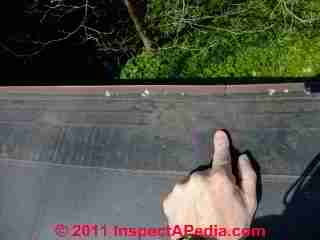 It may seem obvious to say "outset by looking at where you see water leaking into the edifice", simply that is frequently just not enough to track a roof leak back to its source.
Our low slope roof photos shown here requite examples of difficult-to-spot roof leak sources equally well equally subconscious roof leak damage: rot or insect damage.
Our photograph (left, courtesy Galow Homes) shows a small dirt stain marker a minor ponding surface area exactly above what we afterwards discovered was a long-continuing roof leak in an EPDM roof.
- Roof leak water can movement sideways: H2o leaking through roof coverings travels, horizontally besides as vertically (down) the roof slope.
- Roof leak water can move swell distances: Water leaking into a flat or very low slope roof can travel considerable distances before it appears in the edifice interior. The lower the roof slope the greater the distance that water from a roof leak may travel before it shows up indoors.
- Roof leak h2o may leave "dry" footprints: water from roof leaks falling on to an attic flooring or into a ceiling may flow to a lower point at which it enters the building and is noticed;
but when you inspect in the attic, particularly if time has passed since the storm that sent the water through the roof, in that location may be a dry space between what'due south wet now and the actual bespeak of water entry.
At least for repetitive leaks and old leaks, stains and discolored materials may mark the water pathway fifty-fifty if they are dry at the time of inspection.
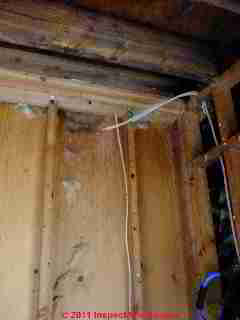 Our roof leak stain photograph (left) shows the wall cavity immediately below the roof expanse I was pointing out in the roof leak photo above.
Equally further demolition showed, the carpenter ants were having a fiesta [Photo] in the wall crenel and along the top plate of this dwelling house.
- Former likewise as current roof leaks leave stains that remain and can confuse the process of tracking downwardly current leaks
- Check first the more obvious leak points: missing flashing, cuts, tears, holes, open up seams, just watch for surprises
- Surprise roof leak points are common: Having a lot of experience with edifice renovation, sabotage, and re-covering gives opportunities to tear older buildings autonomously. That, in turn, gives a real teaching on how, where, and why roof leaks travel where they practice through buildings.
Post-obit roof leaks to their source
- Nosotros start at the signal where h2o or stains are visible in the construction.
- Map the entire wet area, using pencil marks on ceilings, moisture meters, infra-cherry-red.
Watch out: your sense of touch is not a completely reliable indicator of where water has been.
Watch out: moisture meters and infra red cameras (thermography) are slap-up tools for tracking down wet if they are used while things are however wet.
Once a leaked-into area has partially or fully dried, those tools volition non exist reliable indicators of building leaks.
Too, wet meters vary in the depth to which they are able to probe building cavities for moisture. And thermography or infra ruby devices, relying on temperature differences, tin confuse a novice who may mistake a cool area due to missing insulation with a cool area due to wet weather.
- We wait horizontally as well as "upward-slope" from the indicate where water is observed in the building to make a guess at the most probable points of water entry.
- We audit the on-roof surface for even the almost tiny flaw or anomaly that might be a bespeak of water entry at, nigh, or above that probable water entry point.
- Roof test for leaks: We may use a garden hose, where it'south practical, to flow water on or fifty-fifty spray water at a suspected roof leak signal.
Scout out: don't use high pressure level h2o sprays that may damage roofing, or that accident h2o into or through otherwise perfectly-waterproof roof designs; and of form nosotros generally don't spray water at suspect roof areas when there is no visual admission to the roof area from beneath.
- Nosotros seal or repair suspect water entry or leak points and where it's practical nosotros echo our water test
How to Decide if a Roof Leak is Active or Onetime, How to Handle Wet Moldy Areas Discovered in a Ceiling
Question: How do I track downward roof leaks and make up one's mind if leaks are active or inactive? Wet spots & black mold found during interior repairs afterward prior roof leaks and a new roof installation
Nosotros live in a condo edifice, 4 story, concrete construction with brick face up.
Nosotros take had our flat, concrete roof repaired multiple times in the past few years. Last year the roof was sponge-y with water. We had repairs made in all areas as per a building inspector'south advice, and a h2o practiced's advice, except for some tuck pointing problems which were terribly expensive, and didn't look all that problematic . Also we installed roof vents.
This summer the roof is no longer sponge-y. It is solid. But the owners of the quaternary (tiptop) floor apartment are having interior work done and are discovering black mold and water/moisture coming in in the very areas they desire to repair.
The roof LOOKS good, flashing and parapets are tight, caps on parapets are repaired and in good shape, roof surface (modified bitumen) has been sealed this summertime and looks to exist in adept shape.
Is information technology possible this is still water percolating down from our concrete roof? Or should we exist looking for new leaks?
Should we be calling yet another roofer? Or should nosotros be waiting for the interior to be free of the onetime buildup of water which is notwithstanding making its way down from the soggy, sponge-y roof we had last summer.
Thank you for whatsoever advice yous can give us. - M.J.
Respond: Look for & trace moisture or water nether the roof, explore for leaks during mold cleanup, don't wait merely for "blackness mold"
Follow the water pattern and moisture levels to rail downwardly flat roof leaks
If your roof is low slope or flat h2o travels and it can exist catchy tracking downwardly a leak - an inspector using infra red and moisture meters should be able to help sort out the question of whether there is an active leak and if and so where it originates. As yous study that the acme flooring occupant has found wet areas, it seems likely that other than physical and structural members, other wet materials such as insulation volition need to be removed - a step that volition help trace the size and pattern of moisture areas back to inspection points on the roof above.
Roofing over wet materials can lead to farther problem
It'southward common on large commercial buildings and apartments to just add another layer of roofing over leaky flat or low-slope roofs. Sometimes the roofer will also put down a layer of insulating board first. As long as the roof tin can be mechanically secured soundly to the structure, that practice is acceptable in many communities.
Just roofing over wet layers of old textile tin can atomic number 82 to future troubles including
- moisture vapor bubble germination and bulging in the new roof membrane
- difficulty distinguishing between old leaks and new leaks in the covering organization
- connected mold growth in building materials and over longer periods, increased run a risk of rot or insect damage to wood structures
If the roofer roofed over wet conditions they could take a long time to dry out, especially if the roof was installed atop multiple layers of old cloth. Y'all didn't say how long ago the new roof was installed nor whether or non at that place was a tear-off of old layers.
Also, while nosotros like modified bitumen as a roof covering textile, the roof can "look skilful" merely could have improperly made seams.
An experienced roofer or roof inspector volition look closely at the modified bitumen seams and flashing details to be more confident that at least from in a higher place the roof doesn't show obvious leak points.
Encounter MODIFIED BITUMEN ROOFING for details.
Mold Nether Leaky Roofs - some basic advice
Mold that was discovered by the top floor occupants may have been pre-existing due to the previous leakage; that's specially probable given that there were prior roof leaks.
Farther inspection to identify the extent of mold cleanup needed as well equally the source of leakage should be a natural office of mold cleanup. No mold cleanup job would be complete without finding and fixing any remaining building leaks, and no renovation job would be well done if information technology simply covered-over a problematic mold contamination.
Focus on "black mold" is a error. In that location are many genera/species of harmful mold, only some of which are dark in color. The "black molds" are easier to run into so may be over-reported.
It would be unlikely that just 1 genera/species of mold is nowadays in a leaky building, but oft lighter colored mold contagion is harder to encounter, even if it is equally or even more of a potential health business organisation.
Leaky masonry walls remain on your projection - watch out for pelting and storm harm such every bit from Hurricane Irene
Watch out: current of air-blown rain, particularly during storms such as Hurricane Irene that brought long durations of high winds and heavy rainfall, tin penetrate masonry buildings through walls and roof parapets. These masonry wall leaks may be mistaken for roof leaks when they begin high on the edifice walls.
We sympathise the wish to postpone very costly edifice repairs, not to mention the worry that the costly repairs may not be done properly, leading to still more costs. But depending on the materials used and structure of the building walls, leaks into wall cavities can cause such plush impairment that information technology is almost always justified to properly seal the building exterior against storm driven rain leaks.
Reader Comments:
(Oct 25, 2011) leon weech said: excellent web site!
(Dec 18, 2014) Angela Jonse said: Information technology'southward a proficient post.
...
Continue reading at Asphalt SHINGLE FAILURE TYPES or select a topic from the closely-related manufactures below, or see the complete Article Index.
Or see ROOF LEAK DIAGNOSIS FAQs - questions and answers posted originally on this page.
Or see these
Roof Leak Diagnosis & Repair Articles
- ROOF LEAK DIAGNOSIS & REPAIR - home
- Cobblestone SHINGLE FAILURE TYPES
- ASPHALT SHINGLE LIFE / WEAR FACTORS
- ATTIC MOISTURE or MOLD
- CLAY TILE ROOF FLASHING LEAKS
- Common cold WEATHER ROOF TROUBLE
- Baste Edge FLASHING for ROOFS
- Baste EDGE FLASHING for ROOF FAQs
- EARLY ROOF FAILURE DIAGNOSTIC QUESTIONS
- EPDM ROOF LEAK REPAIRS
- EPDM ROOF SEAM REPAIR TAPE
- FLASHING, CHIMNEY Mistakes & Leaks
- FLAT ROOF LEAK REPAIR
- FLAT ROOF Moisture & CONDENSATION
- GREENHOUSE or Solarium ROOF LEAKS
- Hidden MOLD, HOW TO FIND
- LEAKY ROOF DIAGNOSIS & REPAIR
- MOBILE HOME ROOF LEAKS, DEFECTS
- MODIFIED BITUMEN ROOFING
- MEMBRANE & SINGLE PLY ROOFS
- RESOLVING ROOF Job Bug
- RIDGE VENT LEAK PREVENTION
- ROOF ICE DAM LEAKS
- Heat TAPES & CABLES for ROOF Water ice DAMS
- ROOF LEAK DIAGNOSIS FAQs
- ROOF LEAK DIAGNOSIS FAQs-2
- ROOF-WALL FLASHING SNAFU
- SKYLIGHT LEAK DIAGNOSIS & REPAIR
- SLATE ROOF LEAKS
- SLATE ROOF HARDWARE
- SLATE ROOF LEAKS, TEMPORARY REPAIR
Suggested commendation for this spider web page
LEAKY ROOF DIAGNOSIS & REPAIR at AuditApedia.com - online encyclopedia of edifice & ecology inspection, testing, diagnosis, repair, & problem prevention advice.
Or see this
INDEX to RELATED ARTICLES: Article INDEX to Edifice Roofing
Or use the SEARCH BOX found below to Enquire a Question or Search InspectApedia
...
Ask a Question or Search InspectApedia
Questions & Answers diagnosing & repairing leaky roofs
Endeavor the search box just beneath, or if yous adopt, post a question or comment in the Comments box below and we volition respond promptly.
Search the InspectApedia website
Notation: appearance of your Comment beneath may exist delayed: if your comment contains an image, web link, or text that looks to the software as if information technology might be a web link, your posting will announced afterward it has been canonical by a moderator. Apologies for the delay.
Technical Reviewers & References
Click to Show or Hide Citations & References
Publisher InspectApedia.com - Daniel Friedman

Source: https://inspectapedia.com/roof/Roof_Leaks.php
Posted by: beckerdowen1969.blogspot.com
0 Response to "How To Diagnose And Repair Leaking Roof"
Post a Comment